Kingston Plantation Condo Rental Programs: Rules Before You Buy
September 17, 2026
September 17, 2026
Two units come on the market in Kingston Plantation within the same week. Same square footage, same list price, same "resort amenities" line in the listing description. A buyer touring both assumes they're choosing between a view and a floor plan. What they're actually choosing, without realizing it, is which set of rules governs everything that happens after closing: what the unit can be used for, which amenities come with it, and whether a conventional lender will even touch it.
That's the part the listing photos don't show. Kingston Plantation isn't a single homeowners association with one rulebook. It's a master association layered over more than a dozen separate sub-associations, each governing its own building, each with its own dues structure and its own answer to the question that matters most to a buyer weighing lifestyle use against rental income: can this specific unit actually generate the amenity access and rental revenue the price tag implies?
Kingston Plantation sits on 145 acres at the north end of Myrtle Beach, with close to a mile of oceanfront running behind it. That part is consistent no matter which building a buyer walks into. What changes building to building is everything else.
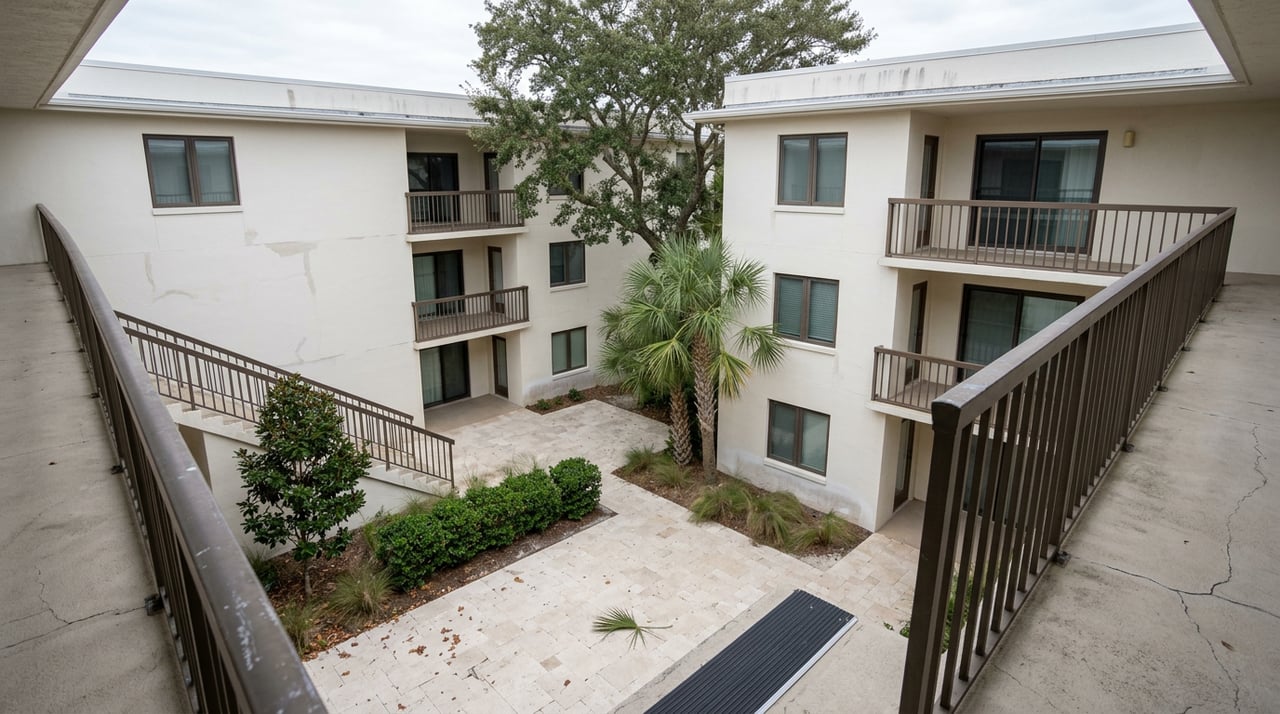
The oceanfront high-rises, Margate Tower, Brighton Towers, North Hampton, South Hampton, and Royale Palms, each operate under their own sub-association. So does each of the villa and townhome sections set back among the property's lakes and gardens: Canterbury Court, Cumberland Terrace, Richmond Park, St. James Park, West Hyde Park, Windermere by the Sea, and Windsor Court, along with the smaller lodge-style buildings like Arrowhead Court and Laurel Court. Each of those has its own dues, its own reserve fund, and its own stance on rentals. A buyer signing a purchase agreement in Kingston Plantation isn't just buying a unit. They're buying into whichever of these sub-associations happens to hold the deed, and that association's rules are what actually govern the unit going forward, not the resort brand on the sign at the entrance.
There's a naming wrinkle worth clearing up here too. The hotel-and-amenity side of the property now operates under the name Kingston Resorts, following a renovation completed in 2022. The residential condominium buildings, the ones a buyer can actually purchase, are still known collectively as Kingston Plantation. Same 145 acres, two names, two different things a buyer might be searching for.
Here's where the real dividing line shows up, and it's not the one most buyers are looking for.
Some Kingston Plantation buildings function as straightforward, individually deeded condominiums where an owner can self-manage, hire an outside property manager, or leave the unit vacant, and nothing about that choice changes their amenity access. Other units sit inside a building where the on-site rental program, run in coordination with the resort's hotel operations, is the gatekeeper for certain amenities. A unit listed as part of that on-site program gets folded into the same guest-facing system that serves hotel visitors. A unit that isn't enrolled doesn't automatically get the same access, even if it sits three floors away in the identical building.
The Embassy Suites tower sits at the far end of this spectrum. Units there operate under a hotel program with mandatory rental pool participation and revenue-sharing arrangements, meaning an owner's use of their own unit is restricted to set periods rather than open access whenever they want it. That's a fundamentally different ownership structure than buying a condo at Margate Tower or in a villa at Windsor Court, and it comes with financing to match: buildings operating under a mandatory rental program or carrying non-warrantable status typically require commercial or portfolio lending rather than a standard conventional mortgage, and portfolio financing usually comes at a higher rate.
This is the part worth sitting with if a rental projection is doing any of the heavy lifting in your decision. The amenity package built during Kingston Resorts' 2022 renovation, the Currents Seaside Entertainment pool complex with its cabanas and waterpark slides, the Black Drum Brewing restaurant that opened in early 2023, the property's additional pools and the Splash! Water Park, exists as a real draw for renters. But whether a given unit's guests get folded into that guest-facing amenity system depends on the building's program status, not on the price the seller is asking.
Monthly HOA dues across Kingston Plantation's buildings run anywhere from roughly $400 to $900 or more, with some of the full-amenity oceanfront towers pushing past $1,000 a month. That's a wide enough range that the number alone doesn't tell a buyer much on its own. What it includes varies just as much as what it costs: some buildings bundle cable, water, trash, and exterior insurance into that fee, others don't, and the only way to know is to request the specific building's dues breakdown rather than assume the range on a listing page reflects a full accounting.
The direction of travel matters here too. Across Grand Strand oceanfront condo buildings generally, HOA fees climbed somewhere between 15 and 30 percent over the two years leading into early 2026, driven mainly by rising insurance premiums and reserve fund catch-up rather than by any expansion in what owners get for the money. Buildings that deferred increases in prior years are now closing that gap faster, which means a fee that looks reasonable on paper today may already be a floor rather than a ceiling.
There's a federal financing rule tangled up in this too. Since 2022, Fannie Mae and Freddie Mac have required condo associations to put at least 10 percent of annual assessments toward reserves to remain eligible for conventional financing. A building that falls short of that threshold risks losing its warrantable status, which affects not just the buyer sitting across the table today but every future buyer trying to resell in that building down the line.
| Building Type | Examples | Rental Structure | Financing Path |
|---|---|---|---|
| Hotel-program tower | Embassy Suites Myrtle Beach Oceanfront Resort | Mandatory rental pool, revenue share, restricted owner-use | Commercial or portfolio lending |
| Individually deeded towers, on-site program optional | Margate Tower, Brighton Towers, North Hampton, South Hampton, Royale Palms | Owner chooses on-site program, outside manager, or self-manage | Conventional if warrantable, portfolio if not |
| Villas and townhomes | Canterbury Court, Cumberland Terrace, Richmond Park, St. James Park, West Hyde Park, Windermere by the Sea, Windsor Court | Typically self-managed or owner-arranged | Generally conventional, verify per building |
None of this shows up clearly in a listing sheet. It shows up in the paperwork, which is exactly why it's worth requesting before an offer goes in rather than during the due diligence period after it's already accepted.
A buyer chasing rental income wants a building where the on-site program is active and where recent HOA minutes show a healthy reserve, since that combination protects both amenity access for guests and financing options for a future resale. A retiree looking for a quiet primary residence might prefer exactly the opposite: a villa building like Windermere by the Sea or St. James Park, where the pace is more residential and the rental program question barely applies. A second-home buyer somewhere in between needs to know, specifically, whether the unit they're touring comes with full resort amenity access or whether that access is something they'd need to arrange separately.
There's no version of Kingston Plantation ownership that's wrong for all three of these buyers. There's just a version that's wrong for the wrong buyer in the wrong building, and the only way to avoid that mismatch is knowing which sub-association and which program status you're actually signing up for before the ink dries.
Does every Kingston Plantation condo allow short-term rentals? No. Rental rules are set at the sub-association level, and they differ by building. Some individually deeded towers permit nightly rentals through an on-site program, some villa sections restrict rentals more heavily, and the Embassy Suites tower operates under a separate mandatory rental pool structure entirely. Always confirm the specific building's rules rather than assuming the resort-wide reputation applies unit by unit.
Is Kingston Resorts the same thing as Kingston Plantation? They occupy the same 145 acres, but they're not interchangeable terms. Kingston Resorts refers to the hotel and amenity operations following the 2022 renovation. Kingston Plantation refers to the residential condominium community, the buildings a buyer actually purchases.
Will my lender treat every building in Kingston Plantation the same way? No. Warrantability status is determined building by building, sometimes based on reserve fund health, insurance coverage, and rental program structure. A unit in one tower might qualify for a conventional mortgage while an identical floor plan in a building with mandatory rental pool participation requires portfolio or commercial financing instead. Confirm this with a lender before making assumptions based on price alone.
If you're comparing units across Kingston Plantation's buildings and want a clear read on which sub-association, program status, and financing path actually fits your goals, Kim Brooks can walk you through the specific documents worth requesting before you write an offer. Schedule a consultation to get started.
This article is general information, not legal, tax or financial advice. Consult a qualified professional about your situation.
She is more than an agent; she is your neighbor and guide to the beach lifestyle. Kim leverages over a decade of real estate experience and a genuine passion for service to help families create lasting memories. Reach out to her for a friendly, results-driven experience.